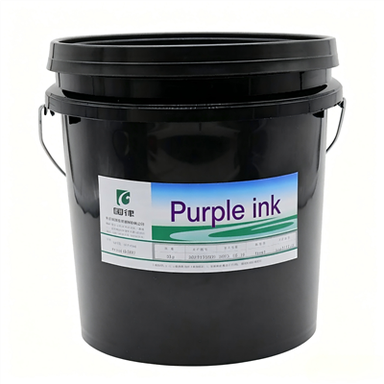
UV Flexographic Ink For Paper Packaging
UV Flexographic Ink for Paper Packaging is a UV-curable printing ink formulated for flexographic printing on paper, paperboard and coated packaging substrates. It uses UV energy to initiate polymerization of reactive components, converting the printed ink layer into a solid film after exposure to the appropriate UV curing system.
The ink is typically formulated from pigments, UV-reactive oligomers and monomers, photoinitiators, and functional additives. During flexographic printing, the ink is transferred from the ink chamber through the anilox roller and printing plate onto the paper or paperboard substrate. After printing, UV irradiation initiates polymerization and cross-linking, producing the final cured ink film. UV flexographic systems are commercially used on paper and paperboard substrates, including packaging and label applications.
- Fast Delievery
- Quality Assurance
- 24/7 Customer Service
Product Introduction
Paper and Paperboard Compatibility
UV Flexographic Ink for Paper Packaging can be formulated for different paper-based substrates.
Uncoated Paper
Uncoated paper has a more open and absorbent surface.
The ink formulation therefore needs appropriate wetting and penetration control to prevent excessive loss of color density.
Coated Paper
Coated paper generally has a smoother surface and lower absorbency.
This can allow:
Better dot reproduction
Higher surface gloss
More defined printed details
Higher apparent color density
Paperboard
Paperboard is commonly used for folding cartons and other packaging structures.
The ink must provide adequate adhesion and resistance while maintaining the required appearance after subsequent converting processes.
Coated Paperboard
Coated paperboard provides a relatively smooth printing surface and is commonly selected when high-quality graphics are required.
Commercial UV flexo products are available for both paper and board substrates.
A UV flexographic ink for paper packaging normally contains several functional components.
| Component | Function |
|---|---|
| Pigments | Provide color and opacity |
| UV-reactive oligomers | Provide film structure and mechanical properties |
| Reactive monomers | Adjust viscosity and participate in polymerization |
| Photoinitiators | Initiate UV curing |
| Dispersants | Improve pigment dispersion |
| Wetting agents | Improve substrate wetting |
| Slip additives | Adjust surface friction |
| Defoamers | Reduce foam during printing |
| Other additives | Control rheology, gloss and surface properties |


The exact formulation varies according to the intended substrate, curing system and end-use requirements.
For food or sensitive packaging, the formulation also needs to be evaluated against the applicable migration and regulatory requirements rather than assuming that all UV inks are suitable for direct or indirect food-contact packaging.
FAQ:
1. What type of paper is suitable for UV flexographic ink?
UV flexographic ink can be formulated for uncoated paper, coated paper, kraft paper, paperboard and coated folding-carton board. The suitable grade depends on substrate absorbency, surface coating, printing speed and the required adhesion and gloss.
2. How do I choose UV flexo ink for coated paperboard?
Consider the paperboard coating, surface smoothness, anilox volume, printing speed and UV curing system. A suitable ink should provide consistent transfer, controlled dot reproduction, sufficient adhesion and complete curing on the specific board.
3. Can UV flexographic ink be used for folding carton printing?
Yes. UV flexographic ink can be formulated for folding-carton applications. When the printed board will undergo die cutting, creasing, folding and gluing, the ink should be evaluated for adhesion, rub resistance, flexibility and compatibility with downstream processes.
4. Why does UV flexo ink sometimes have poor adhesion on paperboard?
Poor adhesion can result from unsuitable ink formulation, excessive ink film thickness, insufficient curing, surface coatings, contamination or incorrect printing conditions. A press trial should evaluate the substrate and curing conditions together rather than changing only the ink.
Hot Tags: uv flexographic ink for paper packaging, China uv flexographic ink for paper packaging manufacturers, suppliers, factory, Flexo Ink, Flexo Printing Ink, Flexographic Ink, Flexographic Printing Inks, UV Flexo Ink, UV Inks for Flexo Printing
No Information