Eight Major Ink Issues You Must Understand To Do A Good Job in Printing
Nov 02, 2023
Ink is an important material for printing. It prints patterns, text, etc. on paper through printing. It is an essential material in the printing industry. Its performance directly affects the printing quality and production efficiency of the product. Today, let’s talk with you about eight major ink issues that need to be paid attention to in printing. Printing is a technology that transfers text, pictures, photos, anti-counterfeiting and other original manuscripts through plate making, ink application, pressure and other processes to transfer the ink to the surface of paper, textiles, plastics, leather, PVC, PC and other materials, and reproduce the contents of the original manuscript in batches . Printing is the process of transferring the approved printing plate to the substrate through printing machinery and special ink.

The fluidity of ink can affect the amount of fountain solution used during printing. During the printing process, one of the reasons for using fountain solution is to make it easier for clean water to form a water film on non-printed parts, making it difficult for the ink to spread to these parts. If the fluidity of the ink is small, it will spread slowly on the printing plate, and the time the ink stays in the non-printed part will be shorter. In this case, we can use a smaller amount of fountain solution.
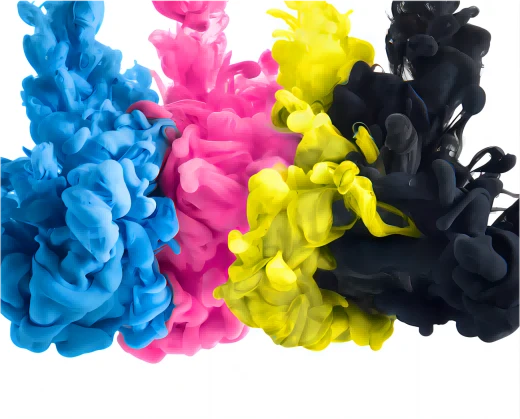
If the ink is emulsified, it will produce the following changes: because after emulsification, the water molecules run into the ink and occupy the space between its original molecules, thus increasing the volume of the ink; also because the water molecules occupy The space occupied by the ink is thus reduced, thereby reducing the proportion of the area occupied by the pigment particles on the ink surface. Because the pigment reflects the color light in the air, allowing us to see the color of the ink, there are fewer pigment particles, and the ink can reflect less light, destroying the hue, brightness and saturation of the ink; water penetrates into the ink, which The viscosity will also decrease accordingly.
03. What are the problems when printing with emulsified ink?
In fact, once the ink is emulsified, its hue, brightness and saturation will be destroyed due to the penetration of water molecules, so printing with these inks will definitely cause a hue shift problem. Since the saturation of the ink is reduced, the amount of ink has to be increased during printing, which will bring about another problem of increasing the solid density value.
Viscosity can also be called internal friction or cohesion. From a physical perspective, its force direction is exactly opposite to the flow direction of the liquid, and it is a resistance to flow. Explained by the ink transfer situation, the viscosity is generated because the ink layer is pulled apart during the transfer process. In order to resist this pulling force, another inward force appears, which is the viscosity. Lithographic printing often requires the ink to have a certain viscosity, so that when the ink is spread on a flat surface, it has a certain adhesion and makes the dots clear; on the other hand, it can equalize the linear speed of the surface of the ink roller, helping to transfer the ink evenly and maintain the ink. A certain thickness of the layer.

05. What problems will occur if the viscosity is too large or too small?
If the viscosity is too high, the ink transfer is likely to be uneven, and the paper wool and paper powder are easy to peel off, but the paper is difficult to peel off from the rubber roller, and the printing quality is greatly affected; when the viscosity is high, the ink will spread slowly on the printing plate. After several rotations of the ink layer on the printing plate, the remaining ink layer is not enough to protect the plate surface. As a result, it will not be able to withstand the pressure of printing and the action of fountain solution, making the printing plate easy to pattern. However, if the viscosity is too small, the ink will be easily emulsified and stained, resulting in poor printing quality.
06. What is the role of the fluidity of ink?
The relationship between fluidity and viscosity is inversely proportional. The greater the fluidity, the lower the viscosity; the smaller the fluidity, the higher the viscosity.
The good fluidity of the ink can ensure the quality of printing to a certain extent, because under the same pressure, the ink can easily spread an ink film of uniform thickness on the surface of the ink roller and maintain good transfer, so that there will be no problem during printing. Uneven dark and light marks appear.
07. How many drying methods are there for ink?
In fact, different inks use different methods to dry the ink according to their characteristics and printing methods. Generally speaking, there are no following types:

Ink oxidation: This drying form of polymerized conjunctiva is the main drying form of lithography;

Penetration drying: When the ink is printed on the paper, its binder will penetrate into the interior of the paper and dry due to the capillary action of the paper fibers;

Developmental drying: After the ink is printed on the paper, only part of it will penetrate into the paper, but most of it will be exerted.
08. Why add desiccant to ink?
When the drying ability of the ink binder itself is not enough to meet the time requirements for printing and color registration, we have to add a drier to the ink to speed up the drying.
The drier can combine with the antioxidant substances in the ink to eliminate and reduce the reaction of the antioxidant substances. In addition, the drier can directly absorb oxygen in the air, making it easier for the ink to obtain the oxygen needed for drying and accelerating oxidative drying.
Only by correctly understanding and understanding the ink issues that need attention in printing can we appropriately adjust and improve certain properties of the ink according to the characteristics of the printing conditions during actual production operations, which will play a role in improving production efficiency and product quality. to better effect.